What are the Best AI Chatbots for Students in 2026?
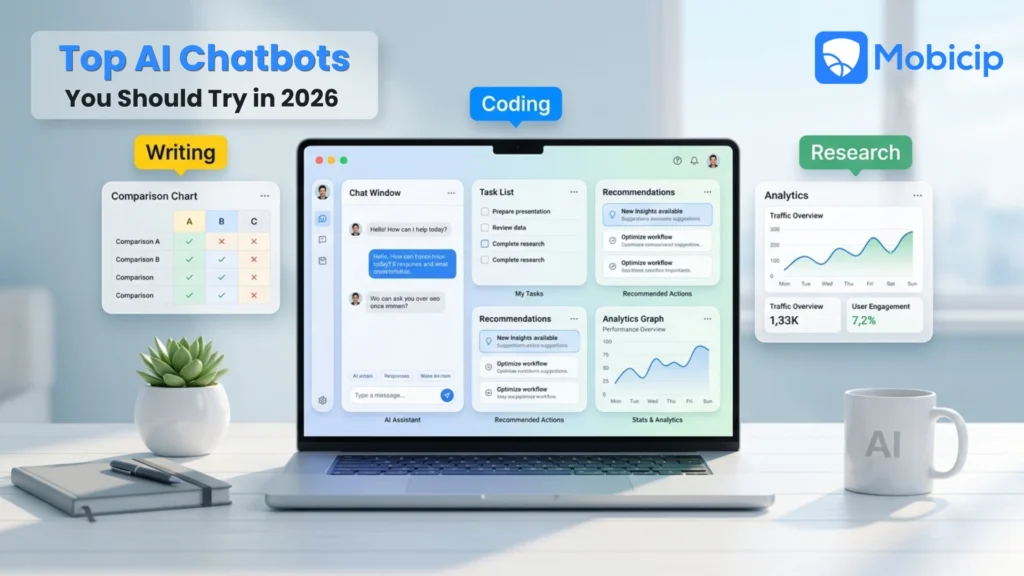
The best AI chatbots for students in 2026 include ChatGPT, Claude, Gemini, Perplexity AI, and Microsoft Copilot. Each platform offers different strengths for writing, research, coding, productivity, and study support. Choosing the right chatbot depends on the student’s learning style, academic needs, and preferred digital tools.
AI chatbots for Students are artificial intelligence-powered software applications used by youngsters for writing, coding, research, and productivity. In 2026, AI chatbots have become mainstream digital assistants, with multiple platforms offering specialized features for different needs.
In this guide, we compare the best AI chatbots in 2026 for students, examining their features, strengths, and ideal use cases so you can choose the right one for your requirements. There’s also a small section on how Mobicip can help with productive AI Chatbot usage by students.
Why Are Students Increasingly Using AI Chatbots?
Students are increasingly turning to AI chatbots because they offer fast, convenient, and personalised assistance in an academic environment that is becoming more demanding and competitive. For students balancing coursework, examinations, deadlines, and extracurricular commitments, accessibility makes them especially attractive.
Several factors explain their growing popularity:
- 24/7 availability: Students can seek help late at night or during study sessions without waiting for teachers or tutors.
- Instant answers: Chatbots provide immediate explanations, summaries, and solutions, saving time.
- Personalised learning: Responses can be adjusted to suit beginner, intermediate, or advanced levels.
- Low-pressure environment: Many students feel more comfortable asking repeated or basic questions without embarrassment.
- Academic productivity: They help with planning schedules, organising notes, and managing deadlines.
- Writing support: Students use chatbots to improve grammar, structure essays, and generate ideas.
- Affordable assistance: Many tools offer free versions, making support accessible to a wider group of learners.
- Technology familiarity: Younger generations are comfortable adopting new digital tools in daily life.
The rise of chatbots among students also reflects broader changes in education, where digital learning resources have become normalised. For many learners, AI chatbots are now seen not merely as novelties, but as practical study companions that complement textbooks, teachers, and online courses.
What Are the Best AI Chatbots for Students in 2026?
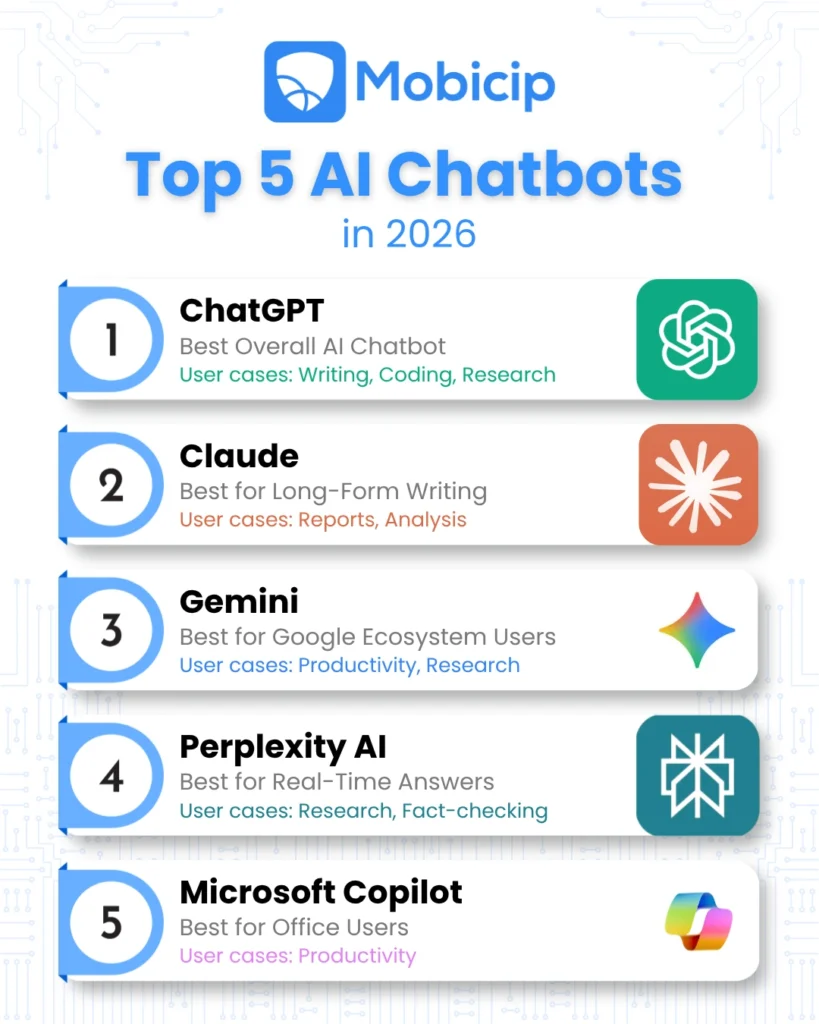
The leading AI chatbots for students in 2026 include ChatGPT, Claude, Gemini, Perplexity AI, and Microsoft Copilot. While some are better for writing or research, others work best for coding, productivity, or integration with Google and Microsoft tools. The best option depends on the student’s specific needs.
As competition has intensified, leading platforms have developed distinct strengths rather than offering identical services. Some excel at creative writing, others at real-time information retrieval, workplace integration, or long-form analysis. As a result, the best chatbot depends less on finding a single winner and more on matching the right platform to the user’s needs. Among the most widely recognised options this year are ChatGPT, Claude, Gemini, Perplexity AI, and Microsoft Copilot, each offering a different balance of capability, usability, and ecosystem.
Why Is ChatGPT the Best Overall AI Chatbot for Students?
ChatGPT is considered the best overall AI chatbot for students because it performs well across writing, coding, brainstorming, research, and productivity tasks. Its versatility, ease of use, and strong contextual understanding make it useful for a wide range of academic and everyday needs.
Owned by OpenAI, ChatGPT was launched in late 2022 and rapidly became the product that brought generative AI into the mainstream. It is now estimated to have hundreds of millions of weekly users worldwide, making it one of the most widely used AI chatbots available.
When it comes to versatility, ChatGPT continues to lead the pack. It excels across multiple domains, making it the go-to AI assistant for most users.
Use cases:
- Writing blogs, essays, and emails
- Coding and debugging
- Research and brainstorming
Why it stands out:
Its ability to handle a wide range of tasks with strong contextual understanding makes it the most balanced AI chatbot available today.
Why Is Claude Best for Long-Form Writing and Research?
Claude is especially useful for long-form writing, reports, essays, and research tasks because it can process large amounts of text clearly and coherently. Students often prefer Claude for structured writing and analytical work that requires deeper context and more detailed responses.
Owned by Anthropic, Claude was first released in 2023 and has grown steadily among professionals, researchers, and enterprise users. While smaller than ChatGPT in mass adoption, it is estimated to serve millions of active users globally.
Claude is particularly strong in handling long documents and nuanced writing tasks. It is widely preferred for academic and analytical work.
Use cases:
- Reports and term papers
- Research analysis
- Structured writing
Why it stands out:
It processes large amounts of text with coherence, making it ideal for serious writing tasks.
Why Is Gemini Best for Students Using Google Tools?
Gemini is a strong choice for students who use Google services such as Gmail, Google Docs, Drive, and Search. Its tight integration with the Google ecosystem makes it especially useful for productivity, research, organization, and managing school-related tasks efficiently.
Owned by Google, Gemini was launched in 2023 as Google’s flagship AI chatbot and assistant, replacing Bard branding in 2024. Backed by Google’s enormous ecosystem, it reaches hundreds of millions of users through search, Android, and Workspace integrations.
Gemini integrates seamlessly with Google’s suite of tools, making it highly effective for users already within that ecosystem.
Use cases:
- Productivity workflows
- Research tasks
- Google Docs and Gmail assistance
Why it stands out:
Tight integration with everyday tools enhances efficiency and convenience.
Why Is Perplexity AI Best for Research and Fact-Checking?
Perplexity AI is best for research because it provides quick answers with citations and real-time information. Students can use it to fact-check information, compare sources, and find reliable summaries, making it especially useful for assignments, reports, and academic research.
Owned by Perplexity AI, Perplexity AI launched in 2022 and quickly built a strong reputation as an AI-powered answer engine. It is estimated to have tens of millions of monthly users, particularly among students, analysts, and knowledge workers.
Perplexity AI is designed for quick, accurate, and up-to-date information retrieval.
Use cases:
- Research
- Fact-checking
- Quick answers
Why it stands out:
Its ability to pull real-time information with citations makes it highly reliable for factual queries.
Why Is Microsoft Copilot Best for Productivity and Microsoft Office Users?
Microsoft Copilot is useful for students who work frequently with Word, Excel, Outlook, and other Microsoft tools. Its built-in integration with Microsoft 365 helps students draft emails, organize documents, automate repetitive tasks, and improve productivity across school projects.
Owned by Microsoft, Microsoft Copilot was introduced in 2023 and expanded rapidly across Windows and Microsoft 365 products. Because it is embedded into widely used workplace software, it reaches hundreds of millions of potential users across enterprise and consumer markets.
Microsoft Copilot is built directly into productivity tools like Word, Excel, and Outlook.
Use cases:
- Productivity
- Document automation
- Email drafting
Why it stands out:
Seamless integration with Microsoft Office tools makes it useful for students.
What Are the Benefits and Risks of AI Chatbots for Students?
AI chatbots can improve productivity, explain difficult concepts, support research, and help students organize their work. However, they also create risks such as overdependence, plagiarism, inaccurate information, weaker critical thinking, and reduced creativity when students rely on them too heavily.
When used responsibly, AI Chatbots can improve understanding, productivity, and confidence. However, their growing popularity also raises important concerns. If relied upon excessively or uncritically, chatbots may weaken genuine learning, create ethical problems, and expose students to inaccurate information. As with any technology, their value depends on how they are used.
Benefits of AI Chatbots for Students
Some of the main educational advantages include:
- Explaining difficult concepts: Breaking down complex topics in mathematics, science, economics, or history into simpler language.
- Homework support: Guiding students through problems, suggesting methods, and checking understanding.
- Essay and assignment help: Assisting with outlines, grammar, structure, and idea generation.
- Revision and exam preparation: Creating summaries, quizzes, flashcards, and practice questions.
- Research assistance: Helping students identify sources, compare viewpoints, and understand unfamiliar topics.
- Language improvement: Enhancing vocabulary, grammar, pronunciation practice, and translation support.
- Coding and technical learning: Supporting programming tasks, debugging code, and explaining logic step by step.
- Time management: Building study timetables, productivity plans, and task lists.
- Confidence building: Allowing students to ask questions privately without fear of embarrassment.
- Creativity and brainstorming: Generating ideas for presentations, debates, projects, and creative writing.
Risks of AI Chatbots for Students
At the same time, several dangers need to be recognized:
- Overdependence and reduced critical thinking: Students may rely on chatbots for answers instead of developing their own reasoning skills.
- Academic dishonesty: Using AI to complete essays, assignments, or examinations without permission may constitute plagiarism or cheating.
- Inaccurate information: Chatbots can generate incorrect, outdated, or fabricated answers confidently.
- Weak writing development: Excessive use for drafting assignments may limit growth in original writing and communication.
- Surface-level learning: Quick answers may discourage deeper reading, reflection, and sustained study.
- Privacy concerns: Students may unknowingly share personal or academic information with online systems.
- Bias and one-sided responses: AI tools may reflect biases in their training data, leading to incomplete perspectives.
- Loss of creativity: Constant dependence on AI-generated ideas may weaken imagination and independent thought.
- Unequal access: Students with paid subscriptions or better technology may gain unfair advantages.
- Reduced teacher interaction: Overuse may replace valuable guidance and mentorship from educators.
How Should Students Choose the Best AI Chatbot?
Students should choose an AI chatbot based on their main needs, such as writing, research, coding, productivity, or study support. Different chatbots have different strengths, so the best option depends on how the student plans to use the tool in everyday learning.
Choosing the right AI chatbot depends on what a student or young user needs help with most. Different chatbots have different strengths: some are better for homework support, some for creative writing, some for quick factual answers, and others for productivity tools. Rather than looking for a single “perfect” chatbot, it is better to choose one that matches your learning style and everyday tasks.
Here is a simple guide for students and youngsters:
- For homework and study help: ChatGPT or Claude for explaining concepts, solving practice questions, and revision support.
- For essay writing and assignments: Claude or ChatGPT for structuring essays, improving grammar, and generating ideas.
- For creative projects: ChatGPT for stories, presentations, brainstorming, and content ideas.
- For quick facts and research: Perplexity AI for fast answers and source-based information.
- For school productivity: Gemini for users who rely on Gmail, Google Docs, Drive, and other Google tools.
- For coding and technical learning: ChatGPT for programming practice, debugging, and learning logic step by step.
- For everyday organisation: Gemini or ChatGPT for schedules, study plans, reminders, and task management.
Are Paid AI Chatbots Better Than Free Versions?
Paid AI chatbots usually offer faster responses, more advanced models, longer memory, and premium features that are not available in free plans. However, free versions are often enough for basic writing, research, and productivity needs, especially for students using AI occasionally.
Most AI chatbots offer free tiers, but premium plans unlock advanced capabilities:
Free plans:
- Basic queries
- Limited usage
- Standard features
Paid plans:
- Faster responses
- Advanced models
- Priority access
- Extended context
If you rely on AI daily, upgrading is often worth the cost.
Students must remember that the best chatbot is one that supports learning rather than replacing effort. Used wisely, these tools can act as tutors, planners, and creative assistants that make studying easier and more effective.
How Can Mobicip Help Students Use AI Chatbots Safely?
Mobicip helps families manage safe AI chatbot use by setting screen-time limits, monitoring access to chatbot apps and websites, reducing distractions, and filtering harmful content. These controls allow students to use AI tools productively while maintaining healthy digital habits and age-appropriate supervision.
Mobicip is a parental control and digital well-being platform designed to help families create safer and healthier technology habits. Rather than banning useful tools outright, it allows parents to guide responsible usage through supervision and sensible boundaries.
Some of the ways Mobicip can support in safer AI chatbot use include:
- Setting daily limits so students use AI chatbots as productive tools without overdependence or endless browsing.
- Managing access to chatbot apps or web platforms according to age, schedule, or family rules.
- Reducing exposure to harmful or inappropriate online material that may be reached through linked searches or browsing.
- Allowing access during homework hours while limiting distractions from unrelated apps and websites.
AI chatbots can be excellent educational aids when used wisely, but younger users often benefit from guidance and structure. Tools such as Mobicip can help families strike a healthy balance between embracing innovation and maintaining safe, responsible digital habits.

What Is the Future of AI Chatbots for Students?
The future of AI chatbots includes more personalized learning, better voice and image support, deeper software integration, and smarter educational tools. Future chatbots are expected to become more interactive and capable of helping students learn, organize tasks, and manage schoolwork more effectively.
AI chatbots are evolving at a remarkable pace and are expected to become even more capable, interactive, and deeply integrated into everyday life. What began as text-based question-and-answer tools is now developing into intelligent digital assistants that can understand context, complete tasks, and work across multiple platforms. For students, professionals, and general users alike, the next generation of chatbots is likely to be far more useful than what exists today.
Some of the key trends shaping the future include:
- Multimodal AI: Future chatbots will combine text, image, voice, and video understanding in a single system. Users may speak naturally, upload images, or receive visual explanations alongside written answers.
- Autonomous AI agents: Instead of only responding to prompts, chatbots may independently complete tasks such as booking appointments, organising schedules, conducting research, or managing workflows.
- Highly personalised assistants: AI systems will better understand user preferences, learning styles, habits, and goals, allowing them to provide more tailored support over time.
- Stronger educational support: Students may receive adaptive tutoring, customised revision plans, and interactive learning experiences.
- Deeper software integration: Chatbots will increasingly work inside email, documents, browsers, phones, and productivity apps rather than as separate tools.
- More natural conversations: Improvements in memory, reasoning, and voice interaction will make chatbots feel more human-like and context-aware.
In the near future, AI chatbots are unlikely to remain simple assistants that answer questions on command. Instead, they will increasingly act as collaborative partners that help users think, learn, create, and manage daily life more efficiently.
FAQs
What is the best AI chatbot for students in 2026?
ChatGPT is widely regarded as the best overall AI chatbot in 2026 because of its strong all-round performance. It performs well across writing, coding, brainstorming, study support, and everyday productivity tasks. While other chatbots may outperform it in specialized areas, ChatGPT remains the most versatile option for the average user.
Are AI chatbots free to use?
Yes, most leading AI chatbots offer free versions that allow users to access basic features and limited usage. However, advanced tools such as faster responses, more powerful models, longer memory, and premium integrations are usually available only through paid subscription plans.
Which AI chatbot is best for writing?
Claude is often considered one of the best AI chatbots for writing, especially for long-form and structured content. It is particularly useful for essays, reports, summaries, and analytical work because it handles large amounts of text clearly and coherently. ChatGPT is also a strong choice for creative and general writing tasks.
Which AI chatbot is best for research?
Perplexity AI is highly regarded for research because it focuses on delivering quick, accurate, and citation-backed responses. It is especially useful for finding up-to-date information, checking facts, and getting concise summaries with sources. Students and knowledge workers often prefer it for information-based tasks.
Is ChatGPT better than Claude or Gemini?
There is no single answer, as each chatbot has different strengths. ChatGPT is generally the most versatile and balanced option, Claude is stronger for long-form writing and deep analysis, while Gemini stands out for users who rely on Google tools such as Gmail, Docs, and Drive. The best choice depends on what you need most.
Conclusion
The rise of AI chatbots marks an important shift in how people access knowledge, organise work, and solve everyday problems. For younger users in particular, these tools offer a glimpse of a future where learning is more interactive, personalised, and immediate than ever before. Yet the real advantage of AI does not lie in getting instant answers—it lies in using technology to ask better questions, explore ideas more deeply, and work more intelligently.
As chatbot technology continues to improve, digital literacy will become just as important as traditional literacy. Students who learn how to evaluate responses, verify information, and use AI ethically will be far better prepared for the world ahead. In that sense, the most valuable skill is not simply knowing which chatbot to choose, but knowing how to use one wisely.